Read Spy Stuff by Matthew J. Metzger Online Free
| Otto Skorzeny | |
|---|---|
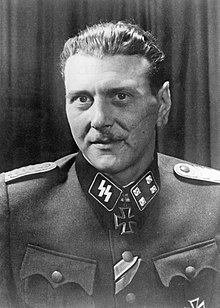 Skorzeny in 1943 | |
| Born | (1908-06-12)12 June 1908 Vienna, Austria-Hungary |
| Died | 5 July 1975(1975-07-05) (aged 67) Madrid, Kingdom of spain |
| Allegiance |  Germany Germany  Argentina (military advisor to Perón)[i] Argentina (military advisor to Perón)[i] |
| Service/ |  Schutzstaffel Schutzstaffel |
| Years of service | 1931–1945 |
| Rank | Obersturmbannführer |
| Commands held | Sonder Lehrgang Oranienburg SS Panzer Brigade 150 |
| Battles/wars | World War Two
|
| Awards | Knight's Cantankerous of the Iron Cross with Oak Leaves |
| Other work | Civil engineer[ citation needed ] |
Otto Johann Anton Skorzeny (12 June 1908 – 5 July 1975) was an Austrian-born German SS-Obersturmbannführer (lieutenant colonel) in the Waffen-SS during World War Ii. During the war, he was involved in a number of operations, including the removal from power of Hungarian Regent Miklós Horthy and the Gran Sasso raid which rescued Benito Mussolini from captivity. Skorzeny led Functioning Greif in which German soldiers infiltrated Allied lines by using their opponents' uniforms, equipment, language and customs. As a effect, he was subsequently, in 1947, charged at the Dachau Military machine Tribunal with breaching the 1907 Hague Convention, merely was acquitted after a former British SOE agent F. F. E. Yeo-Thomas testified that he and his operatives had been prepared to open burn down while wearing German uniforms behind enemy lines.
Skorzeny escaped from an internment campsite in 1948, hiding out on a Bavarian farm as well equally in Salzburg and Paris before eventually settling in Francoist Spain. In 1953, he was offered a job as a military counselor to Egyptian president Gamal Abdel Nasser, which he did not take up. He was an advisor to Argentinian president Juan Perón. In 1963, Skorzeny was allegedly recruited by the Mossad and conducted operations for the agency. Skorzeny died of lung cancer on 5 July 1975 in Madrid at the age of 67.
Pre-war years
Otto Skorzeny was born in Vienna into a middle-class Austrian family unit which had a long history of military service. His surname is of Polish origin, and Skorzeny'southward distant ancestors came from a village chosen Skorzęcin in the Greater Poland region.[ii]
In add-on to his native German, he spoke excellent French and was proficient in English. In his teens, Skorzeny once complained to his father well-nigh the austere lifestyle the family unit was enduring; his begetter replied, "There is no impairment in doing without things. Information technology might even be good for y'all non to get used to a soft life."[3]
He was a noted fencer as member of a German-national Burschenschaft while a university student in Vienna. He engaged in 15 personal combats. The tenth resulted in a wound that left a dramatic dueling scar—known in academic fencing as a Schmiss (German for "smite" or "striking")—on his cheek.[4]
In May 1932 Skorzeny joined the Austrian Nazi arrangement and soon became a member of the Austrian branch of the elite Nazi Sturmabteilung (SA) in February 1934. A charismatic figure, Skorzeny played a pocket-size role in the Anschluss on 12 March 1938 when, according to his own account, he saved the Austrian President Wilhelm Miklas from beingness shot by Austrian Nazis.[five]
Eastern Front
Later on the 1939 invasion of Poland, Skorzeny, then working as a civil engineer, volunteered for service in the German Air Force (the Luftwaffe), but was turned down because he was considered likewise alpine at 1.92 metres (6 ft 4 in) and besides old (31 years in 1939) for aircrew training.[6] He so joined the Waffen-SS, training with Hitler's babysitter regiment, the Leibstandarte SS Adolf Hitler (LSSAH).[7]
Skorzeny took office in the invasion of the Soviet Union with the SS Segmentation Das Reich and subsequently fought in several battles on the Eastern Front end. In Oct 1941, he was in charge of a "technical section" of German forces during the Boxing of Moscow. His mission was to seize important buildings of the Communist Party, including the NKVD headquarters at Lubyanka, and the central telegraph role and other high priority facilities, before they could be destroyed. He was also ordered to capture the sluices of the Moscow-Volga Culvert because Hitler wanted to turn Moscow into a huge bogus lake by opening them.[eight] The missions were canceled as German forces failed to capture the Soviet capital letter.[9]

In January 1942 Skorzeny was hit in the dorsum of the head by shrapnel; he was evacuated to the rear for treatment. He had previously been awarded the Fe Cross, Second Class while fighting in the Yelnya bridgehead. Recuperating from his injuries he was given a staff role in Berlin, where he adult his ideas on anarchistic commando warfare.[6] Skorzeny's proposals were to develop units specialized in such warfare, including partisan-like fighting deep behind enemy lines, fighting in enemy compatible, demolition attacks, etc. In Apr 1943 Skorzeny'due south proper name was put forward by Ernst Kaltenbrunner, the new head of the RSHA, and Skorzeny met with Walter Schellenberg, head of Amt VI, Ausland-SD (the SS foreign intelligence service department of the RSHA). Schellenberg charged Skorzeny with command of the schools organized to railroad train operatives in sabotage, espionage, and paramilitary techniques. Skorzeny was appointed commander of the recently created Waffen SS Sonderverband z.b.Five. Friedenthal stationed most Berlin (the unit was later renamed SS Jagdverband 502, and in November 1944 once again to SS Gainsay Unit "Center", expanding ultimately to five battalions).[10]
The unit'due south first mission was in mid-1943, Operation François. Skorzeny sent a group by parachute into Iran to brand contact with the dissident mountain tribes to encourage them to sabotage Centrolineal supplies of material being sent to the Soviet Spousal relationship via the Trans-Iranian Railway. Yet, commitment among the rebel tribes was doubtable, and Functioning François was deemed a failure.[11]
Operations by Skorzeny
- Operation François – Co-ordination of guerrilla operations in Islamic republic of iran.
- Operation Oak (Unternehmen Eiche, September 1943) – rescue of Italian dictator Benito Mussolini.
- Operation Long Leap – A planned operation to electrocute the "Big Three" (Stalin, Churchill, and Roosevelt) during the 1943 Tehran Conference. The plot was uncovered before its inception. Skorzeny denied that this functioning had e'er existed.
- Operation Knight'southward Bound (Unternehmen Rösselsprung, May 1944) – An attempt to capture Josip Broz Tito alive.
- Operation Armoured Fist (Unternehmen Panzerfaust a.k.a. Unternehmen Eisenfaust, Oct 1944) – kidnapping of Miklós Horthy Jr. to force his begetter, Admiral Miklós Horthy, to resign as Regent of Hungary in favor of Ferenc Szálasi, the pro-Nazi leader of the Pointer Cross Political party.
- Operation Griffin (Unternehmen Greif, December 1944) – A imitation flag operation to spread disinformation during the Battle of the Bulge.
- Werwolf SS – A planned Nazi underground resistance movement in Allied-occupied Europe.
Liberation of Mussolini

Skorzeny (centre, binoculars hanging from cervix) with the liberated Mussolini – 12 September 1943
On the night betwixt 24 and 25 July 1943, a few weeks afterward the Allied invasion of Sicily and bombing of Rome, the Italian Thousand Council of Fascism voted a motility of no confidence (Ordine del Giorno Grandi) confronting Mussolini. On the same mean solar day, the rex replaced him with Marshal Pietro Badoglio[12] and had him arrested.[13]
Hitler ordered military operations to liberate Mussolini, and, as was his common procedure, he issued similar orders to competing organisations within the German language armed services. So he ordered Skorzeny to runway Mussolini, and simultaneously ordered the paratroop General Kurt Pupil to execute the liberation.
Mussolini was being transported around Italia past his captors (start to Ponza, then to La Maddalena, both small islands in the Tyrrhenian Sea). Intercepting a coded Italian radio message, Skorzeny used the reconnaissance provided by the agents and informants (counterfeit British banking company notes with a face up value of £100,000 forged under Operation Bernhard were used to help obtain information) of SS-Obersturmbannführer Herbert Kappler to determine that Mussolini was being imprisoned at Campo Imperatore Hotel, a ski resort at Campo Imperatore in Italy's Gran Sasso massif, high in the Apennine Mountains.
On 12 September 1943, Skorzeny and sixteen SS troopers joined the Fallschirmjäger to rescue Mussolini in a high-risk glider mission. 10 DFS 230 gliders, each carrying nine soldiers and a pilot, towed by Henschel Hs 126 planes started between 13:05 and 13:10 from the Pratica di Mare Air Base well-nigh Rome. The leader of the airborne functioning, paratrooper-Oberleutnant Georg Freiherr von Berlepsch entered the first glider, Skorzeny and his SS troopers saturday in the fourth and fifth glider. To gain acme before crossing the close by Alban Hills the leading three glider-towing airplane units flew an additional loop. All following units considered this manoeuvre unnecessary and preferred non to endanger the given time of arrival at the target. This led to the situation that Skozeny's two units arrived first over the target.[14] Meanwhile, the valley station of the funicular railway leading to the Campo Imperatore was captured at 14:00 in a footing attack past 2 paratrooper companies led by Major Otto-Harald Mors, who was commander-in-chief of the whole raid. They besides cut all telephone lines. At xiv:05 the airborne commandos landed their ten DFS 230 gliders on the mountain near the hotel; only one crashed, causing injuries. The Fallschirmjäger and Skorzeny'south special troopers overwhelmed Mussolini's captors (200 well-equipped Carabinieri guards) without a single shot existence fired; this was too due to the fact that General Fernando Soleti of the Polizia dell' Africa Italiana, who flew in with Skorzeny, told them to stand down. Skorzeny attacked the radio operator and his equipment and stormed into the hotel, existence followed past his SS troopers and the paratroopers. Ten minutes afterwards the beginning of the raid, Mussolini left the hotel, accompanied by the German soldiers. At 14:45 Major Mors accessed the Hotel via the funicular railway and introduced himself to Mussolini.

Subsequently, Mussolini was to exist flown out by a Fieseler Fi 156 STOL plane. Although under the given circumstances the small plane was overloaded, Skorzeny insisted on accompanying Mussolini, thus endangering the success of the mission. After an extremely dangerous simply successful lift-off, they flew to Pratica di Mare. There they continued immediately, flying in a Heinkel He 111 to Vienna, where Mussolini stayed overnight at the Hotel Imperial. The next mean solar day he was flown to Munich and on 14 September he met Hitler at the Wolf'due south Lair Führer Headquarters about Rastenburg.[15]
The landing at Campo Imperatore was in fact led by First Lieutenant Georg Freiherr von Berlepsch, allowable by Major Otto-Harald Mors and nether orders from Full general Kurt Educatee, all Fallschirmjäger (German air force paratroop) officers; merely Skorzeny stewarded the Italian leader correct in front end of the cameras.[ citation needed ] Subsequently a pro-SS propaganda coup at the behest of Reichsführer-SS Heinrich Himmler and propaganda government minister Joseph Goebbels, Skorzeny and his Special Forces (SS-Sonderverband z. b. V. "Friedenthal") of the Waffen-SS were granted the majority of the credit for the functioning.
Operation Long Leap

Skorzeny (2nd from left), 3 Oct 1943
"Functioning Long Spring" was the alleged codename given to a plot to electrocute the "Big 3" (Joseph Stalin, Winston Churchill and Franklin Roosevelt) at the 1943 Tehran Briefing.[sixteen] Hitler supposedly gave the command of the performance to Ernst Kaltenbrunner, main of the RSHA, who, in turn, ceded the mission to Skorzeny. Knowledge of the whole scheme was presented to the Western Allies by Stalin'southward NKVD at the Tehran briefing. The Soviets said they had learned about its existence from counter espionage activities against German intelligence. Their agents had found out the Nazis knew the time and place of this coming together because they had cracked a U.s.a. naval code. Co-ordinate to the NKVD the assassination plot was foiled afterwards they identified the German spies in Iran forcing Skorzeny to call off the mission due to inadequate intelligence.[17]
Post-obit Tehran, the story was treated with incredulity by the British and Americans who dismissed it as Soviet propaganda.[17] Skorzeny supported this view past stating in his mail service-war memoirs that no such operation ever existed.[xviii] He said the story nigh the plans existence leaked to Soviet spy Nikolai Kuznetsov by an SS Sturmbannführer named Hans Ulrich von Ortel was a Soviet invention; Hans Ulrich von Ortel never existed.[xix] [20] Skorzeny claimed his proper name was used just to add credibility to the story considering the NKVD knew his renowned record as an SS commando would make the being of such an operation more plausible.[18] : 193
Raid on Drvar
In early 1944, Sonderverband z.b.V. Friedenthal was re-designated SS-Jäger-Bataillon 502 with Skorzeny staying on as commander. They were assigned to Operation Rösselsprung, known subsequently as the Raid on Drvar. Rösselsprung was a commando performance meant to capture the Yugoslav commander-in-principal, Marshal Josip Broz Tito, who had also recently been recognized by the Allies as the Yugoslav prime minister. Marshal Tito led the Yugoslav Partisan resistance army from his headquarters near the Bosnian town of Drvar, in the center of a large area held by the Partisans.[21]
Hitler knew Tito was receiving Centrolineal support and was aware that either British or American troops might land in Dalmatia along the Adriatic coastline with support from the Partisans. Killing or capturing Tito would non only hinder this, it would give a desperately needed heave to the morale of Centrality forces engaged in occupied Yugoslavia. Skorzeny was involved in planning Rösselsprung and was intended to command it. However, he argued confronting implementation later on he visited Zagreb and discovered that the operation had been compromised through the carelessness of German agents in the Nazi-affiliated Independent State of Croatia in occupied Yugoslav territory.
Rösselsprung was put into action nevertheless, only it was a complete disaster. The commencement moving ridge of paratroopers, post-obit heavy bombardment by the Luftwaffe, jumped betwixt Tito's hideout in a cave and the town of Drvar; they landed on open ground and many were promptly shot by members of the Tito Escort Battalion, a unit numbering fewer than a hundred soldiers. The 2nd wave of paratroopers missed their target and landed several miles out of town. Tito was long gone before paratroopers reached the cavern; a trail at the back of the cave led to the railway tracks where Tito boarded a train that took him safely to Jajce. In the meantime, the Partisan 1st Brigade, from the 6th Lika Partisan Sectionalisation, arrived after a twelve-mile (nineteen-kilometer) forced march and attacked the Waffen-SS paratroopers, inflicting heavy casualties.
Hungary and Operation Panzerfaust

In October 1944, Hitler sent Skorzeny to Hungary after receiving discussion that the Regent of Republic of hungary, Admiral Miklós Horthy, was secretly negotiating with the Red Regular army. The surrender of Republic of hungary would have cut off the million High german troops still fighting in the Balkan peninsula.
Skorzeny, in a daring "snatch" codenamed Operation Panzerfaust (known every bit Operation Eisenfaust in Germany), kidnapped Horthy'due south son Miklós Horthy Jr. and forced his begetter to resign as head of state. A pro-Nazi government under dictator Ferenc Szálasi was then installed in Republic of hungary. In Apr 1945, after German and Hungarian forces had already been driven out of Hungary, Szálasi and his Arrow Cross Party-based forces connected the fight in Austria and Slovakia. The success of the functioning earned Skorzeny promotion to Obersturmbannführer.[22]
Operation Greif and the High german defeat

As part of the German Ardennes offensive in late 1944 (Battle of the Bulge), Skorzeny's English-speaking troops were charged with infiltrating American lines disguised in American uniforms in order to produce confusion to support the German attack. For the entrada, Skorzeny was the commander of a composite unit, the 150th SS Panzer Brigade. As planned past Skorzeny, Operation Greif involved about two dozen German soldiers, most of them in captured American Jeeps and bearded in American uniforms, who would penetrate American lines in the early hours of the Battle of the Bulge to crusade disorder and defoliation.[23] Skorzeny was well enlightened that nether the Hague Convention of 1907, any of his men captured while wearing U.S. uniforms would be executed every bit spies and this possibility caused much discussion with Generaloberst Jodl and Field Align von Rundstedt.[24]
A handful of his men were captured and spread a rumour that Skorzeny personally was leading a raid on Paris to kill or capture General Eisenhower, who was not amused by having to spend Christmas 1944 isolated for security reasons. Eisenhower retaliated by ordering an all-out manhunt for Skorzeny, with "Wanted" posters distributed throughout Allied-controlled territories featuring a detailed description and a photograph.[25] In all, twenty-three of Skorzeny's men were captured backside American lines and xviii were executed equally spies for contravening the rules of war by wearing enemy uniforms.[26] [27]
Skorzeny spent February 1945 as an acting major full general commanding about 5,000 troops, just some of which were his SS commandos and paratroopers, during the defence force of the Schwedt Bridgehead on the River Oder.[28] On 17 March, he received orders to demolition the final remaining intact bridge beyond the Rhine at Remagen following its capture by the Allies, but the span collapsed that same twenty-four hour period, and the naval demolitions squad prepared instead unsuccessfully attacked a nearby Allied pontoon span between Kripp and Linz.[29] Hitler awarded him one of Germany's highest armed forces honours, the Oak Leaves to the Knight'due south Cantankerous.[30]
Postwar
Dachau trials

Skorzeny was interned for two years before being tried every bit a state of war criminal at the Dachau trials in 1947 for allegedly violating the laws of war during the Battle of the Bulge. He and nine officers of the Panzerbrigade 150 were tried before a Us Military Tribunal in Dachau on xviii August 1947. They faced charges of improper utilise of United states of america military insignia, theft of United states uniforms, and theft of Red Cross parcels from U.Southward. POWs. The trial lasted over three weeks. The charge of stealing Crimson Cross parcels was dropped for lack of evidence. Skorzeny admitted to ordering his men to clothing US uniforms, merely his defence argued that as long as enemy uniforms were discarded before combat started, such a tactic was a legitimate ruse de guerre.
On the final mean solar day of the trial, ix September, F. F. E. Yeo-Thomas, a former British SOE amanuensis, testified in defense of Skorzeny and his operatives wearing U.s.a. uniforms behind enemy lines, claiming that the Western Allies had actively contemplated carrying out exactly the same kind of "false flag" operations; the Tribunal subsequently acquitted the ten defendants. The Tribunal drew a distinction between using enemy uniforms during gainsay and for other purposes including deception and were unable to prove that Skorzeny had given whatsoever orders to actually fight in U.Due south. uniforms.[27] [31]
Escape from prison
Skorzeny was detained in an internment camp at Darmstadt pending the decision of a denazification court.[32] On 27 July 1948, he escaped from the military camp with the help of three one-time SS officers dressed in Us Military Constabulary uniforms who entered the campsite and claimed that they had been ordered to accept Skorzeny to Nuremberg for a legal hearing. Skorzeny afterward maintained that the The states authorities had aided his escape, and had supplied the uniforms.[33]
Skorzeny hid out at a farm in Bavaria which had been rented by Countess Ilse Lüthje, the niece of Hjalmar Schacht (Hitler'due south quondam finance minister), for around eighteen months, during which time he was in contact with Reinhard Gehlen, and together with Hartmann Lauterbacher (former deputy head of the Hitler Youth) recruited for the Gehlen Arrangement.[34] Skorzeny was photographed at a café on the Champs Elysées in Paris on 13 February 1950. The photograph appeared in the French press the next day, causing him to move to Salzburg, where he met up with German veterans and besides filed for divorce so that he could ally Ilse Lüthje.[35]
Presently afterwards, with the help of a Nansen passport[ citation needed ] [ dubious ] issued by the Castilian government, he moved to Madrid, where he gear up a small engineering business.[ citation needed ] In April 1950 the publication of Skorzeny's memoirs past the French newspaper Le Figaro caused 1,500 communists to riot outside the journal'due south headquarters.[36]
War machine adviser

In 1952 Egypt was taken over by General Mohammed Naguib. Skorzeny was sent to Egypt the following yr by old General Reinhard Gehlen (who was now working indirectly for the CIA) to human activity as Naguib'south war machine adviser. Skorzeny recruited a staff made up of former SS and Wehrmacht officers to train the Egyptian army. Amidst these officers were former Wehrmacht generals Wilhelm Fahrmbacher and Oskar Munzel; the head of the Gestapo Section for Jewish Affairs in occupied Poland Leopold Gleim; and Joachim Daemling, former chief of the Gestapo in Düsseldorf. In addition to training the regular army, Skorzeny likewise trained Arab volunteers in commando tactics for possible use against British troops stationed in the Suez Canal zone. Several Palestinian refugees also received commando training, and Skorzeny planned their raids into Israel via the Gaza Strip in 1953–1954. One of these Palestinians was Yasser Arafat.[37]
He stayed on to serve as an adviser to Egyptian President Gamal Abdel Nasser.[38]
According to some authors, he travelled between Spain and Argentine republic, where he acted as an advisor to President Juan Perón[39] [one] and as a bodyguard for Eva Perón,[38] [1] while fostering an appetite for the "Fourth Reich" to exist centred in Latin America.[forty] [41] [42]
Alleged recruitment by Mossad
The Israeli security and intelligence magazine Matara published an commodity in 1989 challenge that Skorzeny had been recruited by Mossad in 1963 to obtain information on German language scientists who were working on an Egyptian project to develop rockets to be used against Israel.[43] Reporting on the Matara story, the major Israeli daily Yedioth Ahronot said that it had confirmed the story from their own senior Mossad source.[43] Onetime Mossad head Isser Harel confirmed the story that sometime Nazis were recruited to provide intelligence on Arab countries.[44]
Ian Black and Benny Morris wrote in 1991 that Skorzeny may non have known for whom he was working,[45] merely in 2010, Tom Segev published in his biography of Simon Wiesenthal that Skorzeny had offered to help only if Wiesenthal removed him from his list of wanted war criminals.[46] Wiesenthal refused, but Skorzeny finally agreed to help anyway.[46] Segev gave as his principal source the senior Mossad agent Rafi Meidan to whom Segev attributes the primary role in the recruitment of Skorzeny.[46]
Farther details of the story were published by Yossi Melman and Dan Raviv in 2016.[39] According to their information, a Mossad team had started to develop a program to kill Skorzeny, but chief Isser Harel decided to attempt to recruit him instead, as a man on the inside would greatly enhance their ability to target Nazis who were providing armed services assist to Arab republic of egypt.[39] He allegedly was recruited and conducted operations for Mossad from 1964, working with Avraham Ahituv and Rafi Eitan. [47]
Other unnamed sources[39] asserted Skorzeny was recruited later Mossad visited his abode in Kingdom of spain, where he expected that he would be assassinated. After undergoing teaching and preparation in the Mossad's facilities in Israel, the rumoured piece of work for Mossad included assassinating German language rocket scientist Heinz Krug who was working for the Egyptian authorities and posting a letter bomb which killed v Egyptians at the Egyptian military rocket site Manufactory 333. He also allegedly supplied the names and addresses of German language scientists working for Egypt and the names of European front companies supplying military hardware to Egypt.[39]
No confirmed source can explain Skorzeny'due south motives for working with State of israel, but he may have craved run a risk and intrigue and feared assassination by Mossad.[39] An commodity featured in Der Spiegel on 22 Jan 2018 raised doubts as to the involvement of Skorzeny in Krug's death, stating that Mossad dominate Isser Harel ordered the murder.[48]
Other activities
Like thousands of other old Nazis, Skorzeny was declared entnazifiziert (denazified) in absentia in 1952 by a West German government mediation board, which meant that he could now travel from Espana into other Western countries, on a special Nansen passport for stateless persons[ why? ] with which he visited Ireland in 1957 and 1958. In late 1958, he qualified for an Austrian passport and in 1959, he purchased Martinstown House, a 165-acre (67 ha) farm in County Kildare. Although Skorzeny could not be refused entry without due crusade, he was refused a residency visa by the Irish authorities and had to limit his stays to half dozen weeks at a time, and he was monitored past G2. He rarely visited after 1963 and sold Martinstown Business firm in 1971. At six ft four in (193 cm) and weighing 18 stone (110 kg; 250 lb), forth with his scar, he was hands recognizable and caused speculation among the English language and Irish press equally to why he was in Ireland. I Kildare resident recalled Skorzeny as someone who "wasn't particularly friendly and [who] didn't really mix with local people".[1] [49] Skorzeny also owned property on Majorca.[50]
In the 1960s, Skorzeny prepare upwards the Paladin Group, which he envisioned equally "an international directorship of strategic assault personnel [that would] straddle the watershed between paramilitary operations carried out by troops in uniform and the political warfare which is conducted by noncombatant agents". Based virtually Alicante, Spain, the Paladin Group specialized in arming and training guerrillas. Some of its operatives were recruited by the Spanish Interior Ministry to wage a hole-and-corner war against the separatist group ETA.[51]
Skorzeny was a founder and an counselor to the leadership of the Spanish neo-Nazi group CEDADE, established in 1966.[52]
It is rumoured[ by whom? ] that under the cover names Robert Steinbacher and Otto Steinbauer and supported past either Nazi funds or (co-ordinate to some sources) past Austrian intelligence, Skorzeny gear up a underground organization named Die Spinne (English: "The Spider"), which helped as many as 600 former SS men escape from Germany to Kingdom of spain, Argentina, and from there to other countries.[53] [54] Over the years, Skorzeny, Gehlen, and their network of collaborators supposedly gained enormous influence in Europe and Latin America.[ citation needed ]
Death
In 1970, a cancerous tumour was discovered on Skorzeny's spine. Ii tumours were later removed while he was staying at a hospital in Hamburg, but the surgery left him paralyzed from the waist downward. Vowing to walk over again, Skorzeny spent long hours with a concrete therapist; and, within six months, he was back on his anxiety. Skorzeny died of lung cancer on five July 1975 in Madrid. He was 67 years onetime.[55] At no point in his life did Skorzeny ever denounce Nazism.[1]
He was given a Roman Cosmic funeral Mass in Madrid on 7 August 1975. His body was cremated later, and his ashes were subsequently taken to Vienna to be interred in the Skorzeny family unit plot at Döblinger Friedhof.[ commendation needed ] His funerals in Madrid and Vienna were attended by former SS colleagues who gave the Hitler salute,[39] [56] and also sang some of Hitler's favourite songs.[39] [57] [ verification needed ]
Skorzeny was portrayed in the boob tube drama serial Mussolini: The Untold Story and Mussolini and I,[58] and the drama film Walking with the Enemy (2014).[59]
Awards
- Fe Cross (1939) 2nd Class (26 August 1941) & 1st Grade (12 September 1943)[60]
- Knights Cross of the Iron Cross, 13 September 1943; Oakleaves, ix Apr 1945 (826th)[61]
See as well
References
- ^ a b c d e Crutchley, Peter (xxx Dec 2014). "How did Hitler's scar-faced henchman become an Irish gaelic farmer?". BBC. Archived from the original on 30 December 2014. Retrieved 25 December 2016.
- ^ Otto Skorzeny, My Commando Operations: The Memoirs of Hitler's Most Daring Commando, p. 40
- ^ "IU Southeast : Indiana University Southeast". Homepages.ius.edu. Archived from the original on 25 June 2013. Retrieved 25 December 2016.
- ^ Foley, Charles (1999). Commando Extraordinary: Otto Skorzeny. Cassel. p. thirty. ISBN0-304-35080-X.
- ^ Wagner, Dieter; Gerhard Tomkowitz (1971). Anschluss: The Calendar week Hitler Seized Vienna. St. Martin's Press. p. 170.
- ^ a b Williamson, Gordon (2009). German Special Forces of Earth War II . Oxford: Osprey. p. 20. ISBN978-1-84603-920-one.
- ^ "Otto Skorzeny". world wide web.jewishvirtuallibrary.org. 1998 - 2019 American-Israeli Cooperative Enterprise. Archived from the original on 4 May 2019. Retrieved 4 May 2019.
- ^ Ganzenmüller, Jörg (18 July 2011). Blockade Leningrads: Hunger als Waffe Archived 28 April 2019 at the Wayback Machine. Zeit Online; retrieved six November 2011 (in German).
- ^ Nagorski, Andrew (2007). The Greatest Battle: Stalin, Hitler, and the Desperate Struggle for Moscow That Inverse the Course of World State of war Two. Simon & Schuster. p. 202. ISBN978-0-7432-8110-two.
- ^ Mitcham, Samuel W. (2006). Panzers in Wintertime: Hitler's Ground forces and the Boxing of the Bulge. Greenwood Publishing Group. p. 29. ISBN0-275-97115-5.
- ^ Skorzeny, Otto (1950), Skorzeny'south Secret Missions, New York: EP Dutton and Company Inc.
- ^ Whittam, John (2005). Fascist Italy. Manchester University Press. ISBN0-7190-4004-three. Archived from the original on 25 September 2020. Retrieved 18 November 2020.
- ^ Annussek, Greg (2005). Hitler's Raid to Save Mussolini. Da Capo Printing. ISBN978-0-306-81396-2.
- ^ Óscar González López (2007). Fallschirmjäger at the Gran Sasso. Valladolid: AF Editores. ISBN978-84-96935-00-half-dozen.
- ^ Erich Kuby: Verrat auf deutsch. Wie das Dritte Reich Italien ruinierte. Hoffmann und Campe, Hamburg 1982, ISBN 3-455-08754-Ten.
- ^ Nikolai Dolgopolov (29 Nov 2007). "How "The Panthera leo And The Bear" Were Saved". Rossiiskaya Gazeta. Archived from the original on 10 July 2012. Retrieved 9 June 2009.
- ^ a b O'Sullivan, Donal (2010). Dealing with the Devil. New York. pp. 203–04. ISBN9781433105814. Archived from the original on 31 March 2019. Retrieved thirty March 2016.
- ^ a b Skorzeny, Otto (2007). Meine Kommandounternehmen. Winkelried, Dresden. pp. 190–92. ISBN978-3-938392-11-9.
- ^ Kern, Gary (2003). "How 'Uncle Joe' Bugged FDR". Studies in Intelligence. Center for the Written report of Intelligence. 47 (1). Archived from the original on 5 September 2020. Retrieved 18 June 2012.
- ^ Havas, Laslo (1967). Hitler's Plot to Kill the Large 3. New York: Cowles Volume Co. OCLC 13309.
- ^ Eyre, Wayne D. Operation Rösselsprung and the Emptying of Tito, 25 May 1944: A Failure in Planning and Intelligence Support. http://www.dtic.mil/dtic/tr/fulltext/u2/a403840.pdf Archived 21 February 2017 at the Wayback Machine, p. vi
- ^ Prof. Nikolaus von Preradovich: Österreichs höhere SS-Führer. Vowinckel, Berg am Run across 1987; ISBN 3-921655-55-2, p. 317.
- ^ Delaforce, Patrick (2006). The Battle of the Bulge: Hitler'due south Final Run a risk. Pearson Education. ISBN1-4058-4062-5.
- ^ Mitcham, Samuel Due west. (2008). Panzers in Winter: Hitler's Army and the Battle of the Bulge. Greenwood Publishing Group. p. 30. ISBN978-0-275-97115-1.
- ^ Lee, p. 32
- ^ Michael Reynolds (one February 2006). Men of Steel: I SS Panzer Corps: The Ardennes and Eastern Front, 1944-45. Casemate Publishers. p. 58. ISBN1-9320-3351-3.
- ^ a b Koessler, Maximilian (January 1959). "International Law on Utilise of Enemy Uniforms As a Stratagem and the Amortization in the Skorzeny Case". Missouri Police Review. 24 (one). Archived from the original on seven January 2021. Retrieved 2 December 2015.
- ^ Smith, Stuart (2018). Otto Skorzeny – The Devil's Disciple. U.k.: Osprey/Bloomsbury. p. 212. ISBN978-ane-4728-2945-0.
- ^ Rottman, Gordon L. (2013). World War 2 river assault tactics. Oxford: Osprey. p. 36. ISBN9781780961088.
- ^ Scherzer, Veit (2007). Die Ritterkreuzträger 1939–1945 Die Inhaber des Ritterkreuzes des Eisernen Kreuzes 1939 von Heer, Luftwaffe, Kriegsmarine, Waffen-SS, Volkssturm sowie mit Deutschland verbündeter Streitkräfte nach den Unterlagen des Bundesarchives [The Knight'southward Cross Bearers 1939–1945 The Holders of the Knight's Cross of the Atomic number 26 Cross 1939 by Army, Air Force, Navy, Waffen-SS, Volkssturm and Allied Forces with Germany Co-ordinate to the Documents of the Federal Archives] (in German). Jena, Germany: Scherzers Militaer-Verlag. p. 708. ISBN978-3-938845-17-2.
- ^ Staff (ten September 1947). "Court Holds Former SS Officer and Seven Aides Did Not Violate the Rules of War During Battle of Bulge". The New York Times. Archived from the original on nineteen October 2013. Retrieved 11 Feb 2017.
- ^ "Token from Der Fuhrer". Time. ix Baronial 1948. Archived from the original on 27 July 2021. Retrieved 27 July 2021.
- ^ Lee, pp. 42-43
- ^ Lee, pp. 43-44
- ^ Lee, p. 45
- ^ "The Press: Fools & Opposition". Fourth dimension. 5 June 1950. Archived from the original on 27 July 2021. Retrieved 27 July 2021.
- ^ Infield, Glenn B. Skorzeny: Hitler's Commando, NY: St. Martin'south Press, 1981.
- ^ a b John South. Craig. "Peculiar liaisons: in war, espionage, and terrorism in the twentieth century" Archived 31 March 2019 at the Wayback Auto, Algora Publishing, 2005; ISBN 0-87586-331-0/ISBN 978-0-87586-331-three. pg. 163
- ^ a b c d e f thou h Raviv, Dan; Melman, Yossi (27 March 2016). "The Strange Example of a Nazi Who Became an Israeli Hitman". Haaretz. Archived from the original on 27 March 2016. Retrieved 25 December 2016.
- ^ "Barbie's Postwar Ties With U.S. Army Detailed". Boston Globe. xiv February 1983.
- ^ Infield
- ^ Wechsberg, pp. 81, 116
- ^ a b "Ex-Ss Homo worked for Mossad against Egyptian rocket project". Jerusalem Post. 20 September 1989.
- ^ Ian Black (21 September 1989). "Israelis recruited SS colonel every bit agent". The Guardian. p. 12.
- ^ Ian Black and Benny Morris. Israel'southward Hugger-mugger Wars. Futura. p. 198.
- ^ a b c Tom Segev (2010). Simon Wiesenthal: The Life and Legends . Doubleday. pp. 164–165. ISBN9780385519465.
- ^ Bergman, Ronen (2018). "v". Ascension and Kill Starting time: The Secret History of Israel'due south Targeted Assassinations. Random Firm. ISBN9781473694712.
- ^ Rosenbach, Marcel (22 Jan 2018). ""Raketen-Krug": Mordauftrag vom Mossad-Chef". Der Spiegel. Archived from the original on 24 January 2018. Retrieved 21 February 2018 – via Spiegel Online.
- ^ Terence, O'Reilly (2008). Hitler's Irishmen. Mercier Press. ISBN978-ane-85635-589-6.
- ^ Snyder, Louis Leo (2005). Hitler'south Henchmen: The Nazis who Shaped the Third Reich. David & Charles. p. 315. ISBN0-7153-2033-5.
- ^ Lee, p. 185
- ^ Lee, p. 186
- ^ "Otto Skorzeny, Nazi Commando, Dead". The New York Times. 8 July 1975.
- ^ "Nazis: The Mortiferous Spider". Newsweek. 21 July 1975.
- ^ Deutsche Biographische Enzyklopädie, volume nine Schmidt - Theyer, K.G. Sauer, Munich 1998; ISBN 3-598-23169-5
- ^ How a famous old Nazi officer became a hitman for Israel Archived 26 June 2020 at the Wayback Machine- Retrieved 15 March 2017
- ^ Huggler, Justin (29 March 2016). "Hitler's commando Lt-Col Otto Skorzeny 'worked as an assassin for Israeli intelligence'". The Telegraph. Archived from the original on 12 January 2022.
- ^ Mitchell, Charles P. (17 September 2002). The Hitler Filmography: Worldwide Feature Film and Television receiver Miniseries Portrayals, 1940 through 2000. McFarland. ISBN9780786445851. Archived from the original on 21 February 2022. Retrieved 10 Apr 2017 – via Google Books.
- ^ "Flick tells true story of Hungarian Jew's infiltration of Nazi SS". St. Louis Jewish Light. Archived from the original on 17 February 2020. Retrieved 17 Feb 2020.
- ^ Thomas 1998, p. 329.
- ^ Fellgiebel, Walther-Peer (ane January 2003). Aristocracy of the Tertiary Reich: The Recipients of the Knight's Cantankerous of the Fe Cross, 1939-45. Helion & Company Limited. ISBN9781874622468. Archived from the original on 9 Oct 2021. Retrieved 21 April 2017 – via Google Books.
Bibliography
- Annussek, Greg (2005). Hitler'south Raid To Relieve Mussolini Archived one Apr 2019 at the Wayback Motorcar, Da Capo Printing, ISBN 0-306-81396-three.
- Durschmied, Erik (1990), Don't Shoot the Yanqui, Grafton Books, ISBN 0-246-13631-6.
- Durschmied, Erik (2001), Whisper of the Blade, Coronet Books, ISBN 0-340-77084-8.
- Foley, Charles (1987), Commando Boggling, Arms & Armour, ISBN 0-85368-824-9.
- Infield, Glenn (1981), Secrets of the SS, Stein and Day, ISBN 0-8128-2790-two.
- Lee, Martin A. (1999). The Creature Reawakens: Fascism'south Resurgence from Hitler'southward Spymasters to Today'southward Neo-Nazi Groups and Right-Wing Extremists. Taylor & Francis. ISBN0-415-92546-0.
- Skorzeny, Otto, David Johnson transl. (1995), My Commando Operations: The Memoirs of Hitler'south Most Daring Commando, Schiffer Publishing, ISBN 0-88740-718-8.
- Skorzeny, Otto (1997), Skorzeny's Special Missions, Greenhill Books, ISBN i-85367-291-2.
- Smith, Stuart (2018), Otto Skorzeny - The Devil'southward Disciple, Osprey/Bloomsbury, ISBN 978-1-4728-2945-0.
- Tetens, T. H. (1961), The New Germany and the Old Nazis, Random House/Marzani & Munsell; LCN 61-7240.
- Thomas, Franz (1998). Dice Eichenlaubträger 1939–1945 Ring 2: L–Z [The Oak Leaves Bearers 1939–1945 Volume two: 50–Z] (in German). Osnabrück, Germany: Biblio-Verlag. ISBN978-iii-7648-2300-9.
- Wechsberg, Joseph (1967), The Murderers Among U.s.—The Simon Wiesenthal Memoirs, McGraw Hill, LCN 67-13204.
- Whiting, Charles (1998), Skorzeny: "The Most Dangerous Man in Europe", DaCapo Press; ISBN 0-938289-94-2.
[1]
External links

- My Commando Operations by Otto Zkorzeny.
- Trial of Otto Skorzeny and Others, General Armed forces Regime Court of the U.S. Zone of Deutschland, 18 August to nine September 1947
- Summary of KV 2/403 a British intelligence file Archived 2 April 2014 at the Wayback Motorcar Declassified in July 2001 information technology details the post war debriefing of Otto Skorzeny on Operation Werewolf and other matters
- Paper clippings nigh Otto Skorzeny in the 20th Century Printing Archives of the ZBW
- Otto Skorzeny interrogated by a US Army captain in Federal republic of germany
- ^ "המוסד: סיפור כיסוי". mossad. Archived from the original on xv December 2019. Retrieved 15 Dec 2019.
Read Spy Stuff by Matthew J. Metzger Online Free
Source: https://en.wikipedia.org/wiki/Otto_Skorzeny
0 Response to "Read Spy Stuff by Matthew J. Metzger Online Free"
Post a Comment