How to Work While Disabled in the Arts Without Making Too Much

Jamila Rahimi works at Art Enables on a Monday afternoon. Rahimi, who has been working at the studio since 2006, creates the structure of her drawings with permanent marker before adding colour. Becky Harlan/NPR hide explanation
toggle caption
Becky Harlan/NPR

Jamila Rahimi works at Art Enables on a Monday afternoon. Rahimi, who has been working at the studio since 2006, creates the structure of her drawings with permanent marking before adding color.
Becky Harlan/NPR
Teenagers frequently accept to await years to practise the things they want to do — drive, drinkable, vote. Just for Mara Clawson, it was something different.
As a teen, Clawson loved making art — specifically cartoon with pastels.
And so at 14, she reached out to Art Enables, a studio, gallery and vocational program in Washington, D.C., where she really wanted to make that fine art. Only Art Enables requires its members to be at to the lowest degree 21 years erstwhile.
That didn't deter her. During the vii-year expect, Clawson stayed focused.
She and her parents kept in shut impact with the gallery, and she submitted piece of work to its exhibits as a special guest. After about 2,500 days, Clawson finally joined the ranks.
Meet some of the artists at Art Enables, an art studio, vocational program and gallery for artists with disabilities in Washington, D.C.
Maia Stern/NPR YouTube
Fine art Enables is a lot similar any other arts studio — information technology has big windows and a paint-splattered sink, it's quiet enough to hear a paintbrush clink the sides of a h2o drinking glass, and, of class, it's full of fine art.
Those things attracted Clawson, only she was also drawn to the artists who brand upwards the studio — artists, like her, who take a inability of some kind.
Clawson, who yet works in pastels merely has branched out into digital art, was born with familial dysautonomia, a neurogenetic disorder that affects her autonomic nervous system.
"Art is my life," she writes on her website, and Art Enables is one identify she engages in that life.

A paint-splattered sink and open watercolor palette evidence signs of art in progress at Art Enables, a studio for people with disabilities that was founded in 2001. Creative person Vanessa Monroe, who has been interested in art since childhood, concentrates as she paints a canvas at Fine art Enables. "We're just like family," she says about existence part of the studio. Becky Harlan/NPR hide explanation
toggle explanation
Becky Harlan/NPR

A paint-splattered sink and open watercolor palette bear witness signs of art in progress at Art Enables, a studio for people with disabilities that was founded in 2001. Artist Vanessa Monroe, who has been interested in fine art since childhood, concentrates as she paints a canvas at Art Enables. "We're simply like family," she says about existence function of the studio.
Becky Harlan/NPR
"Our mission is to assist artists build a career in the arts," says executive managing director Tony Brunswick. "Fine art Enables is not an art therapy program; it's not an arts teaching plan. We're a professional studio."
Artists regularly showroom piece of work in the on-premises galleries, and visitors can buy that art. When I visited, in that location were a number of red dots indicating "sold" on the works in the show. This is a business organisation — artists earn income from the sales and piece of work to build their personal brands.

Artists work in the Fine art Enables studio and gallery in Northeast Washington, D.C., on a Monday afternoon in June. Becky Harlan/NPR hide explanation
toggle caption
Becky Harlan/NPR

Artists work in the Fine art Enables studio and gallery in Northeast Washington, D.C., on a Monday afternoon in June.
Becky Harlan/NPR
When I first met Clawson, I could see the focus on art as a profession — she immediately handed me her business carte du jour. Shawn Payne, whose fine art depicts designs of high-fashion shoes, talked to me about his efforts to build up his social media presence. Nonja Tiller, a comic creative person, showed me a children's book she is illustrating called The Ugly Puppy — a story about a dog with a disability who is taunted by other dogs. Once the volume is finished, she hopes to sell copies at local stores.
"I'm trying to let people know who we are," Tiller said as she flipped through her illustrations. "We're humans; we're like anybody else."

Nonja Tiller holds 1 of her comics (left) illustrating two characters bullying another for being different. "I'm trying to let people know who we are," she says. "Nosotros're humans; we're like anybody else." This Super Mario Brothers-inspired kicking was painted by Shawn Payne, whose piece of work is influenced past way designers like Christian Louboutin. He hopes his work will include wearables one day. Becky Harlan/NPR hibernate caption
toggle caption
Becky Harlan/NPR

Nonja Tiller holds 1 of her comics (left) illustrating two characters bullying another for being dissimilar. "I'm trying to permit people know who we are," she says. "We're humans; we're similar anybody else." This Super Mario Brothers-inspired kicking was painted by Shawn Payne, whose work is influenced by manner designers like Christian Louboutin. He hopes his work volition include wearables i twenty-four hour period.
Becky Harlan/NPR
But all this takes money. Art Enables (and programs like information technology across the country) aren't costless to run. While artists do depict acquirement from their piece of work, there is a fee to participate in the program.
About half of the artists in Art Enables' studio were referred through the city's Department on Inability Services, which classifies the studio as an employment readiness program. When an artist joins Art Enables through DDS, virtually seventy percent of the cost is covered by a waiver plan funded by the Centers for Medicare and Medicaid Services, while local funding covers the balance.
So for Art Enables and the artists who participate, the congressional debate over the wellness intendance bill is of particular interest. In its current state, the Republican nib would impose more than $700 billion worth of cuts to Medicaid over 10 years.

Inspired past an image of Jesus Christ's Final Judgment, artist Raymond Lewis creates a detailed ink cartoon in the Art Enables studio. Becky Harlan/NPR hide caption
toggle caption
Becky Harlan/NPR
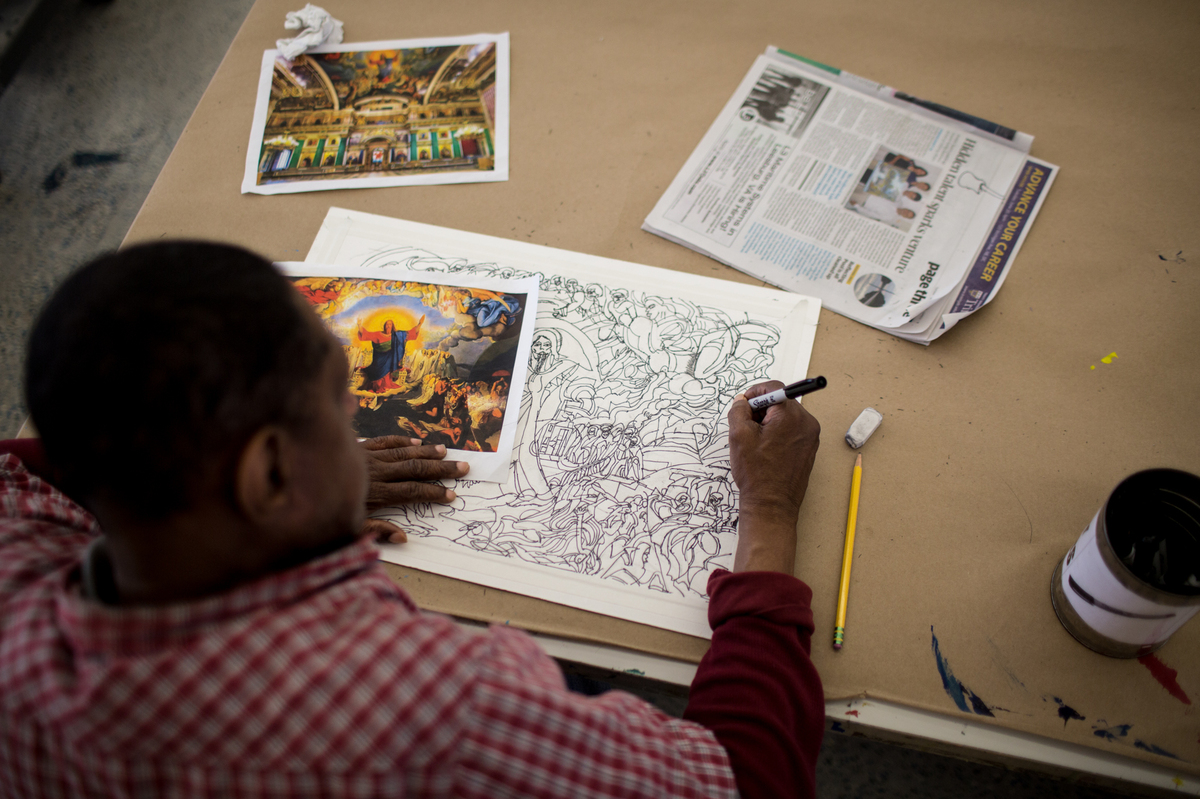
Inspired past an image of Jesus Christ'southward Last Judgment, artist Raymond Lewis creates a detailed ink cartoon in the Fine art Enables studio.
Becky Harlan/NPR
"We're dealing with a lot of uncertainty ... We're waiting to see which fashion things go," says Thomas Jared Morris, the deputy director for the Developmental Disabilities Administration at DDS. "Hopefully we're protecting the funding that nosotros've been able to take advantage of over the years."
The cost of non funding Art Enables, though, could also exist loftier.
"If folks didn't accept vocational opportunities like this to participate in, it just means that they're not edifice the opportunity to build an contained income," says Brunswick. "It means that they're more dependent on supportive programs and services than they would otherwise be, which is why at that place'south been a real push button on vocational services."

Artist Imani Turner works on a watercolor piece inspired past the solar system. "Art creates opportunities for all of us to learn almost ourselves," says Tony Brunswick, the executive director of Art Enables. "We actually believe in the power of art." Becky Harlan/NPR hide caption
toggle caption
Becky Harlan/NPR

Creative person Imani Turner works on a watercolor slice inspired by the solar arrangement. "Art creates opportunities for all of us to learn near ourselves," says Tony Brunswick, the executive director of Art Enables. "Nosotros actually believe in the power of art."
Becky Harlan/NPR
Employment rates for folks with disabilities can be pretty low. In D.C., about 33 percent of working-age people with disabilities are employed, compared with about 79 percentage of working-age people overall, co-ordinate to a 2015 American Customs Survey. Employers "still don't desire to hire people with disabilities," says Morris, who has been in the field of human being services for fourteen years.
From his bespeak of view, whatever exposure that highlights the talents of the long-marginalized customs is good exposure.
When a passersby walk off of busy Rhode Island Avenue into Art Enables and autumn in dear with a hand-painted birdhouse or a sketch before learning that it was fabricated past someone with a disability, that piece of art has the opportunity to augment their perspective. In other words, allowing fine art and artists to do what they best.

"Outsider Fine art Inside the Beltway" reads the sign in a higher place the door to Art Enables, an art studio, gallery and vocational plan in Northeast Washington, D.C., that works with artists who take disabilities. Becky Harlan/NPR hide caption
toggle caption
Becky Harlan/NPR

"Outsider Fine art Inside the Beltway" reads the sign higher up the door to Art Enables, an art studio, gallery and vocational program in Northeast Washington, D.C., that works with artists who have disabilities.
Becky Harlan/NPR
blanchettefaverry.blogspot.com
Source: https://www.npr.org/sections/ed/2017/07/16/537016761/art-studio-helps-adults-with-disabilities-turn-their-passion-into-a-career
0 Response to "How to Work While Disabled in the Arts Without Making Too Much"
Post a Comment